RESEARCH


Research Methodologies – Qualitative & Quantitative
Interviews:
Gadija Jappie – Cape Malay Woman
Archival Research:
District Six Archives
Cape Town Historical Organisation
The Mail & Guardian, News24, The Sunday Times
Bo Kaap Museum
Websites:
Cape Town Magazine
Cape Town Tourism
Books:
A History Of The Cape Town Minstrel Festival, The Colorful Stories, Songs, History Of The Kaapse Klopse, Cape Malay Cuisine
Research Information
Cape Town is a melting pot of culture. The Cape Malay community shaped the city's history and contributed to a vast tapestry of South African traditions (Exploring Cape Malay Culture | Cape Town Travel, 2021). The culture is born from a dark and heavy past, burdened by displacement and slavery. Still, it continues to grow into one of the liveliest and most colourful cultures exclusive to South Africa (The Cape Malay | South African History Online, 2021).
Initially, the Cape Malay people came from Indonesia, among other South-East Asian countries, and were transported here as slaves by the Dutch East India Company. As the slave trade over the 17th and 18th centuries continued, the Dutch proceeded to bring more people into the Cape from different parts of the world - India, East Africa, Brazil, Madagascar and the Cape Malay community grew.
Cape Malay were ethnically identified as 'Coloureds' and spoke Afrikaans (The Cape Malay | South African History Online, 2021).
The heart of the culture is the Cape Malay kitchen, filled with a colourful array of spices, bredie, bobotie and frikkadels. The pulse of the culture is its music sung and celebrating folk songs, in style not appropriated or copied in any other culture (Bo-Kaap Cape Town's Vibrant Houses, History and Cape Malay Cuisine - Story at Every Corner, 2021). The soul of the culture is a celebration of life, freedom and rebellion through colour. Colour is visually represented in Cape Malay culture through clothing, food choices, painted houses and celebratory carnivals.
The Cape Minstrel Carnival or 'Tweede Nuwe Jaar' is a celebratory street parade that creates a burst of colour in Cape Town every year and is rooted in the slave history of Cape Town. Thousands gather to watch performers known as the Kaapse Klopse don colourful suits, glittery uniforms and face paint as they parade through the streets in song and dance.
The street party dates back to the colonial era when slavery was rife in South Africa. Slaves were given one day off a year, the 2nd of January. While their masters slept off the debauchery of New Year's day, slaves used the day for revelry and self-expression through vibrant colour, song and dance. In 1674, by decree of Isbrand Broke, the Cape Governor, slaves began to join their masters in celebrating New Year's Day and accepting clothing, money, and tobacco offerings. As part of their celebrations, the slaves paraded in the streets, singing serenades (The Colorful Stories, Songs, History Of The Kaapse Klopse, 2021). Today, the celebrations continue as a means of traditions, preserving age-old custom as well as revelry and entertainment (Collison, 2021).


Originally the houses in Bo-Kaap were leased to the slaves and had to be painted plain white. After the emancipation of slaves in 1830, slaves were allowed to buy the houses, and the new owners painted the houses in bright, happy colours as an expression of freedom and joy. The colourful houses were also an escape from the monochromatic life representative of British colonialism.
During the 1970s, the apartheid government segregated areas by race, not permitting coloured to have any identity or ownership of a place through house numbers or even street names, making directions impossible. The colourful houses were used as a means of identification and defiance against an oppressive regime (Bo-Kaap Cape Town's Vibrant Houses, History and Cape Malay Cuisine - Story at Every Corner, n.d.).


ANALYSIS
I have lived in Cape Town for nearly 20 years, driving past the colourful houses in Bo Kaap daily, eating Cape Malay cuisine amas with colour and marvelling the vibrant colours and costumes of the Cape Carnival. Yet, not once have I thought to question the reasoning behind such a colourful culture.
The heart and soul of Cape Malay culture is a celebration of life, freedom and rebellion through colour. Colour is an integral part of the design process, used to attract attention, group related elements, convey meaning and enhance aesthetics. I am intrigued and in awe of a culture that uses the medium of colour for more.
To the Cape Malay, colour is an integral part of a tradition passed on from generation to generation to celebrate life, family and community. During slavery, colour was a means to escape the monochromatic life of British Colonialism. When slavery was abolished, colour was used as an expression of freedom. During the apartheid era, colour was used in rebellion and open defiance against an oppressive regime.
One has to marvel at a culture with such a dark past of slavery and oppression that used their hardships to fuel and shape a vibrant, joyful culture built around colour. South Africa today is plagued by economic difficulties, racial division, poverty and endemic corruption. We could draw inspiration from a culture unique to our country that used colour to celebrate life and freedom despite hardships.

The Cape Malay community shaped the city's history and contributed to a vast tapestry of South African traditions, most importantly, vibrant expression through colour. The culture is born from a dark and heavy past, burdened by displacement and slavery. Still, it continues to grow into one of the liveliest and most colourful cultures exclusive to South Africa and Cape Town.
The heart and soul of Cape Malay culture is a celebration of life through the use of colour. During slavery, colour was a means to escape the monochromatic life of British Colonialism, later an expression of freedom. During apartheid, colour was used to rebel against an oppressive regime.
I would like to create a book that shows the Cape Malay culture as a celebration of life through colour and illustrates a different path to the defeat, hatred and misery circumstance can bring. The book would be as colourful and vibrant as the culture itself and inspire hope desperately needed today in South Africa, a country plagued by economic hardship, poverty, tribal and racial division.


Interviews:
PC Janse Van Rensenburg: Curator of History at the Amathole Museum during the 1980’s
Lolonga Tali: Education Officer at the Amathole Museum currently
Archival Research:
Amathole Museum Huberta the Hippo Archives
New York Times Archives: 6 September 1931, 7 June 1931
The Mail & Guardian, 2020
Websites & Blogs:
Amathole Museum, Mahlanti Musings, Getaway Magazine
Books:
The Story of the Hippopotamus Who Became Famous, Huberta's Journey, Huberta The Untold Story, Huberta Goes South
Research Information
Huberta the Hippopotamus was a South African treasure and rose to local and international fame in the 1920s. In November of 1928, she left her quaint watering hold for green pastures and began her 'Great Trek south from St. Lucia Estuary in Zululand to the Eastern Cape of South Africa. The journey spanned over three years, with many site-seeing deviations along the route, encompassing over 1600 kilometers (The curious adventure of Huberta Hippopotamus, 2021).

Fig. 13: Natures Heart, n.d.
Akin to Forest Gump, Huberta's solo pilgrimage garnered many adventures along the route. Many have theorized the reasoning behind her journey, from fleeing the hunters who killed her parents or to search for her long-lost mate. Local tribesman suggested she was visiting the hippos' ancestral haunts who previously lived further south (Huberta, n.d.).
Both young and old were captivated by the impossibility of her wanderings. The travelling hippo ate her way through gardens, parks and farms, all the while evading humans through her nightly travels (Huberta, n.d.). There are records of her swimming at a beach in Durban, bathing in a monastery garden, and entering a local theatre. She almost caused a train crash after sleeping on the tracks, overturned a boat when visiting a zoo, disrupted a golf match, ate a policeman's cap - and created an uproar when she walked into the city, Durban.
Huberta's grand escapades were keenly followed by South Africans of all races, making her the Unions most famous tourist. The press could not get enough of Huberta, and the crowds, curious to catch a glimpse of her, gathered along the route. She would often show up on the spot and trot down the main-street helping herself to local fruit stands while crowds watched on in amazement. The media attention grew to an international level, with major worldwide newspapers reporting on Huberta's journey (Steemit, 2018).

Fig. 14: New York Times, 1931.

Her popularity was contagious, and she became the national pet of South Africa and loved worldwide. (The curious adventure of Huberta Hippopotamus, 2021). Some were entertainment and amused by her exploits, others were moved to write poetry, and some believed Huberta was the home of a mighty spirit. The Hindus in Kwa-Zulu Natal proclaimed her "Protector of the Poor". Local Indians ceremonially deified Huberta. The Zulu's believed Huberta to be the reincarnation of their king, Tshaka Zulu. The Xhosa felt the animal was the spirit of a great chief who had returned to find justice for his people (The Mail & Guardian, 2021).
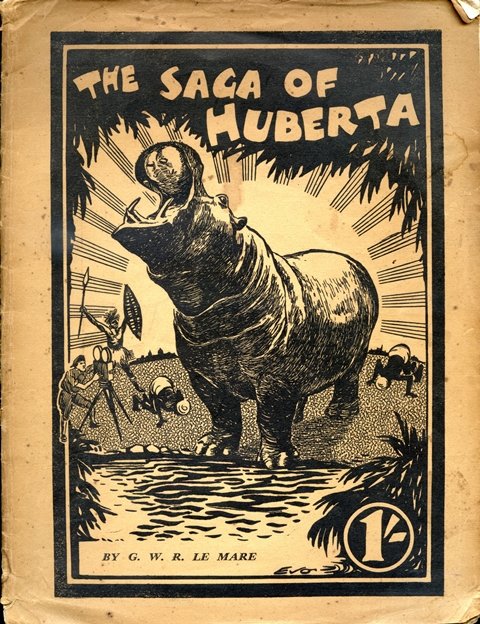
Fig. 16: Atlas Obscura, n.d.
Tragically, her life ended in 1931. Although she'd been declared "Royal Game" by the Natal Provincial Council, meaning that she was protected, four farmers killed her near King William's Town. The public, House of Assembly and police were involved in bringing the culprits to book. Marx and Hattingh families were convicted and fined 25 pounds each for the murder. The family lines were demonized by the public and decimated by accidental deaths and financial ruin in the years to come (Mrs Ball et al., 2021).
This was a national and international tragedy. Huberta's death was widely mourned, sympathy cards and donations for Huberta poured in with letters received from far afield as Philadelphia in the United States. In Verulam flags flew at half-mast. The people of Pietermaritzburg sent a magnificent floral wreath in memory of Huberta. Huberta's remains were sent to England for mounting and returned from London. Public interest was insurmountable, with memorial exhibitions in Durban, Witwatersrand Agricultural Society, Rand Easter Show and East London seeing thousands in attendance. She is now exalted at the Amathole Museum in King Williams Town (The curious adventure of Huberta Hippopotamus, 2021).

Fig. 17: Jstor, 2004.
The legend of Huberta lives on today in books, magazines and newspaper articles.
ANALYSIS
I grew up in King Williams Town, where a large monument pays tribute to Huberta. I was read stories as a child of Huberta's adventures and grand voyage but never considered the reasoning behind her rise to fame. None of the books, newspaper articles, archives or interviews explain why a hippopotamus won the hearts of South Africans and foreigners alike?
South African history during the 1920's was one of post-war depression and a society racially and culturally divided as the English fought the Afrikaans over mining and labour, and the Hertzog government began introducing the restrictive legislation against native black Africans that lead to Apartheidheid. During this challenging time, the most unlikely of creatures inspired hope, collaboration, and a setting aside of differences both in South Africa and abroad.
South Africans of all races and the international press were fascinated by Huberta's slow and sometimes challenging journey south. They took up the story of the travel hippopotamus, and Huberta became a celebrity overnight. Everyone loved the courage hippopotamus on a mission of her own!
Zulu's, Xhosa and Mahlatini tribes found common ground in Huberta, believed to be a great spirit that drew worship and excitement from tribes that have been warring against one another for centuries. The Afrikaners found a kindred spirit on a journey similar to the 'Great Trek'. Dutch-speaking South Africans migrated east by wagon through treacherous terrain and bloodshed to live out of British colonial rule's reach (Great Trek 1835-1846 | South African History Online, 2011). To others, Huberta was a source of amusement, entertainment, inspiration and hope during a time of economic hardships and post-war depression.
With so much cultural division in the country at that time, I don't think anyone realized that they had set their difference aside and found common ground in the hope and inspiration a Hippopotamus represented. Huberta was a symbol that inspired hope and patriotism during a time that was sorely lacking.
South Africa is plagued by economic hardship, poverty, tribal and racial division. We are a nation in desperate need of hope and inspiration. We need the legend and symbolism of Huberta now more than ever, perhaps to replace the national springbok emblem, seen as a representation of Apartheid to many black South Africans. Huberta united a nation once before; I think it is time she is used wisely to do so again.

Huberta left her watering hole in Zululand in 1928 and journeyed 1600 kilometres south over three years. The travelling hippo ate her way through gardens, parks, golf courses and farms - visiting a zoo and bathing in a monastery.
Local and international news alongside South Africans of all races keenly followed the escapades of Huberta, the 'Unions most famous tourist' and 'national pet.'
Despite being protected, she was tragically shot and killed by farmers in 1931 near King William's Town.
I would like to create a book that pays tribute to Huberta the Hippopotamus and turns the legend into a symbol of hope and inspiration desperately needed today in South Africa, a country plagued by economic hardship, poverty, tribal and racial division.

As a South African, I have been fascinated by African patterns but grown tired of a stereotypical, gimmicky representation of them in design; I wanted to remove all colour and give them a sophisticated tactile presentation much like the fabric designs from Finland and Marimekko. The topic proved too extensive for this project. It did reveal a multidisciplinary British-Nigerian artist named Yinka Ilori who uses African patterns in a playful, colourful and contemporary way.
https://yinkailori.com/about
It made me look at African patterns from a different angle and realise that I didn't need to remove African design's very heart, colour to present them in a different light. In-fact, the embracing of colour could, in itself, reframe the African pattern narrative.
This perspective was instrumental in my research of the Cape Malay culture, centred around colour as a means of expression.


Reference: Story at Every Corner. n.d. Bo-Kaap Cape Town's Vibrant Houses, History and Cape Malay Cuisine - Story at Every Corner. [online] Available at: <https://storyateverycorner.com/bo-kaap-cape-town/> [Accessed 7 March 2021].
Reference: Southafrica.net. 2021. SatRenovationFrontend. [online] Available at: <https://www.southafrica.net/za/en/travel/article/the-colour-of-cape-malay-culture> [Accessed 5 March 2021].
Reference: Cape Town Travel. 2021. Exploring Cape Malay Culture | Cape Town Travel. [online] Available at: <https://www.capetown.travel/exploring-cape-malay-culture/> [Accessed 5 March 2021].
Reference: Story at Every Corner. 2021. Bo-Kaap Cape Town's Vibrant Houses, History and Cape Malay Cuisine - Story at Every Corner. [online] Available at: <https://storyateverycorner.com/bo-kaap-cape-town/> [Accessed 5 March 2021].
Reference: Sahistory.org.za. 2021. The Cape Malay | South African History Online. [online] Available at: <https://www.sahistory.org.za/article/cape-malay> [Accessed 5 March 2021].
Reference: Capetownmagazine.com. 2021. The Colorful Stories, Songs, History Of The Kaapse Klopse. [online] Available at: <https://www.capetownmagazine.com/kaapse-klopse> [Accessed 5 March 2021].
Reference: Collison, L., 2021. A History Of The Cape Town Minstrel Festival. [online] Culture Trip. Available at: <https://theculturetrip.com/africa/south-africa/articles/history-cape-town-minstrel-festival/> [Accessed 5 March 2021].
Reference: Sahistory.org.za. 2011. Great Trek 1835-1846 | South African History Online. [online] Available at: <https://www.sahistory.org.za/article/great-trek-1835-1846> [Accessed 6 March 2021].
Reference: Museum.za.net. n.d. Huberta. [online] Available at: <https://www.museum.za.net/index.php?option=com_content&view=article&id=36&Itemid=159> [Accessed 5 March 2021].
Reference: Getaway Magazine. 2021. The curious adventure of Huberta Hippoippo. [online] Available at: <https://www.getaway.co.za/travel-news/the-history-of-huberta-the-hippo/> [Accessed 5 March 2021].
Reference: Mrs Ball, a., prayer, K., Legislation, A., The Time Family of Zwelitsha, 1., Variants, B. and Hotel, T., 2021. The Killing of Huberta and its legacy. [online] Museum.za.net. Available at: <https://www.museum.za.net/index.php?option=com_content&view=article&id=68:the-killing-of-huberta-and-its-legacy&catid=25&Itemid=168> [Accessed 5 March 2021].
Reference: The Mail & Guardian. 2021. On the trail of Huberta Hippoippo - The Mail & Guardian. [online] Available at: <https://mg.co.za/article/2001-10-10-on-the-trail-of-huberta-hippo/> [Accessed 5 March 2021].
Reference: Mahlatini musings. 2021. The delightfully dotty adventures of Huberta the Hippo - Mahlatini musings. [online] Available at: <https://www.mahlatini.com/blog/2012/05/the-delightfully-dotty-adventures-of-huberta-the-hippo/> [Accessed 5 March 2021].
Reference: Steemit.com. 2018. HUBERTA THE HIPPO — Steemit. [online] Available at: <https://steemit.com/steemiteducation/@frieda/huberta-the-hippo> [Accessed 5 March 2021].
Reference: Guttedarcades.blogspot.com. 2021. Huberta the hippopotamus. [online] Available at: <http://guttedarcades.blogspot.com/2012/09/huberta-hippopotamus.html> [Accessed 5 March 2021].
(South Africa - Conflict in the 1920s, n.d.)
Reference: Countrystudies.us. n.d. South Africa - Conflict in the 1920s. [online] Available at: <http://countrystudies.us/south-africa/21.htm> [Accessed 5 March 2021].
Reference: Van Rensburg, P., 2021. The History & Symbolism behind Huberta the Hippo.
Reference: Khali, L., 2021. Huberta the Hippo.
Image 1: & Beyond, 2021. Private cultural dining experience. [image] Available at: <https://www.andbeyond.com/experiences/africa/south-africa/cape-town/cultural-dining-experience/> [Accessed 7 March 2021].
Image 2: AfroTourism, n.d. The Famous Carnival in Cape Town. [image] Available at: <http://afrotourism.com/travelogue/celebrating-new-years-day-in-enchanting-cape-town/> [Accessed 7 March 2021].
Image 3: Culture Trip, n.d. A History Of The Cape Town Minstrel Festival. [image] Available at: <https://theculturetrip.com/africa/south-africa/articles/history-cape-town-minstrel-festival/> [Accessed 7 March 2021].
Image 4, 5, 6: Rack, J, 2021. Kaapse Klopse Cape Minstrels. [image] Available at: <https://www.flickr.com/photos/seo_marketing/albums/72157662957050081> [Accessed 7 March 2021].
Image 7: News24, n.d. No, there won't be a casino in heritage-rich Bo-Kaap. [image] Available at: <https://www.news24.com/news24/southafrica/news/no-there-wont-be-a-casino-in-heritage-rich-bo-kaap-20200804> [Accessed 7 March 2021].
Image 8: Flickr, 2021. Colourful Bo-Kaap. [image] Available at: <https://www.flickr.com/photos/dmjames58/32084457498/in/photostream/> [Accessed 7 March 2021].
Image 9: Booking.com, n.d. Stunning House in Bo Kaap. [image] Available at: <https://www.booking.com/hotel/za/stunning-house-in-bo-kaap.html> [Accessed 7 March 2021].
Image 10: South African Tourism, n.d. The colour of Cape Malay Culture. [image] Available at: <https://www.southafrica.net/za/en/travel/article/the-colour-of-cape-malay-culture> [Accessed 7 March 2021].
Image 11, 16, 18: Atlas Obscura, n.d. Huberta the Hippo. [image] Available at: <https://www.atlasobscura.com/places/huberta-the-hippo> [Accessed 7 March 2021].
Image 12: De Beer, P, 2021. Huberta the Hippo in the Amatole Museum. [image]
Image 13: Natures Heart, n.d. https://www.naturesheart.co.za/blogs/the-birding-blog/flying-flags-for-hippos. [image] Available at: <https://www.naturesheart.co.za/blogs/the-birding-blog/flying-flags-for-hippos> [Accessed 7 March 2021].
Image 14, 15: New York Times, 1931. AFRICA MOURNS ITS PET HIPPO; Huberta, the Heroine of Amusing Escapades, Was Known in Many Towns and Villages. [image] Available at: <https://www.nytimes.com/1931/06/07/archives/africa-mourns-its-pet-hippo-huberta-the-heroine-of-amusing.html> [Accessed 7 March 2021].
Image 17: Jstor, 2004. The making of an animal biography. [image] Available at: <https://www.jstor.org/stable/41056519?seq=1> [Accessed 7 March 2021].
Image 19, 20, 21, 22: Vogue, 2020. Yinka Ilori’s Joyful Homewares Are The Colourful Boost Your Flat Needs This Winter. [image] Available at: <https://www.vogue.co.uk/arts-and-lifestyle/article/yinka-ilori-interview> [Accessed 7 March 2021].