RESEARCH
Research user-centred design processes.
Service design is a new field in graphic design and describes improving user service quality. It is achieved through planning and organising people, infrastructure, communication and material components of a service to enhance its quality and the interaction between the service provider and customer (Stickdorn, M., Schneider, J., Andrews, K. and Lawrence, A., 2011).
Service design is based on five principals
User-centred: Services experienced through the customer's eyes.
Co-Creative: Service design involving other people as part of the process.
Sequencing: Visualising a service through a sequence of interrelated actions or critical moments in a customer's journey.
Evidencing: Making customers aware of a service's elements to create loyalty and understanding of the service experience.
Holistic: The entire service environment is considered.
Various tools are available to designers to assist with service design. (Value Proposition Canvas | Service Design Tools, n.d.).
https://servicedesigntools.org
Service design is about making a helpful service usable, efficient, effective and desirable (UK Design Council, 2010).
ANALYSIS
Campaigns and service design projects that tackle social issues.
The History of Service and Social Design
Social design is ethically motivated to supports change and innovation. Artists and designers have collaborated to disrupt political and social injustice throughout history, with time and technology increasing the audience reach exponentially.
In the beginning, social design affected those who came into contact with the message, from graffiti on the walls of Pompeii to political jokes scrawled on the walls of Roman buildings. During the Industrial Revolution, the rise of the printing press allowed mass production to reach a broader audience. William Hogarth's Gin Lane poster illustrates the evils of drinking gin and culminated in the 1751 Gin Act and a reduction in gin shops. Around 1927, Russian promoted communism through ROSTA cartoon-like window posters distributed through stencils to allow for mass production and distribution. Mexico's 1919 mural renaissance protested the 1919 Diaz dictatorship and showed the revolutionary illustrations of indigenous Mexicans, history, and society through Diego Rivera's murals on public property.

Fig. 1: Wikipedia, n.d.

Fig. 2: Wikipedia, n.d.
In 2011 the left-wing Occupy Wall Street movement used social media to mobilise society to abolish inequality. The 20th Century has seen an exponential rise in demonstrations and activism aided by social media's far-reaching power (Service Design and Saving the World. GDE720. Week 9, Lecture. [Accesssed 09 February 2021]).
Campaigns and service design that tackle social issues
The Center for the Study of Political Graphics, founded by Carol A. Wells, is an educational and research archive of over 90,000 human rights and protest posters. These relate to historical and contemporary movements for social change and advance art's power, educate and inspire people to take action (Political Poster Renaissance | Communication Arts, n.d.). Images can be forgotten, but by taking a powerful image and turning it into a poster, it stays in people's minds, refocusing our thoughts and provoking us into asking questions that change us. When various posters on the same topic are viewed in an exhibition together, the message is impactful and influential.

Fig. 3: Center for the Study of Political Graphics, 2021.
Featured in this exhibition is a poster by The Art Worker's Coalition showing the 1968 My Lai Massacre Q: And Babies? A photographic image of Vietnamese children's dead bodies across a dirt road overlays by red text, which reads Q: And babies? A: And babies? The quote was taken from an interview with one of the soldiers present during the massacre. It is one of the most important posters of the 20th Century as it helped stop the Viet Nam War by swaying public opinion (Q: and babies? A: and babies, n.d.).

Fig 4. Saam, n.d.
A poster created by a Polish art student Tomasz Sarnecki in 1989, Solidarność W samo południe, 4 Czerwca, was featured on a Polish magazine cover ten years after its creation with the title 'The poster that changed Polish History'. It shows Gary Cooper in a scene from "High Noon" with Solidarność logo behind him and over his badge holding a ballot instead of a pistol. It was taken by Polish Solidarity and given to the CIA without the artist's permission. It was printed and distributed on mass the evening before the population would vote for the communist party or polish solidarity. The act of creativity inspired the polish population to vote the communist party out (Wells, C, 2015).
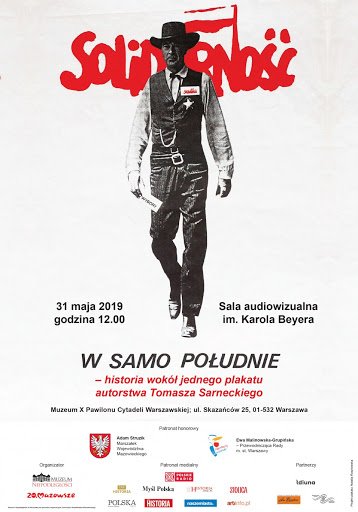
Fig. 5: Sarnecki Tomasz, n.d.
The Art Against War exhibition currently running in the Millennium Gallery in Sheffield showcases works by UK based artist Peter Kennard. His powerfully political work is a visual manifestation of resistance against economic inequality, war, climate change and injustices, both local and global (Peter Kennard, n.d.). He used photomontage to show the victim and the victimiser together, encouraging people to think critically about a subject.
His creation for the CND, "Haywain with Cruise Missiles", is a sardonic montage articulating British society's fears of an east-west stand-off and potential nuclear catastrophe. John Constable's Haywain is recreated, shown bristling with American cruise missiles. Leader of the Greater London Council, Ken Livingstone, in reaction to the poster, commissioned Kennard to give visual expression to his declaration that the capital was a "nuclear-free zone" (ART AGAINST WAR - PETER KENNARD & THE CND | The Uneasy Shuffling of Feet, n.d.).

Fig. 6: Stop Watch Gallery, n.d.
The Iraq war in 2003 prompted Kennard, in collaboration with Cat Phillips, to create one of the archetypal images of the conflict. Photo Op, picturing a grinning Tony Blair posing for a selfie in front of burning oil wells in an arid landscape, highlights Blair's controversial Iraq policy. Blair was perceived as arrogant and blind to the problems unleashed by Iraq's invasion, and the poster provoked a violent insurgency, including the sabotage of oil wells and pipelines (Photomontage, n.d.).

Fig. 7: Kennard, n.d.
Exhibitions like Art Against War and those exhibited by The Center for Political Graphics illustrate social designs goal to leave the world a better place and evidence changes to society, perception and policy throughout history.
WORKSHOP CHALLENGE
Task 1: User-centred design processes that can be used to discover a core need, insight or solve a problem.
Service Design can benefit from resources and materials best suited to a specific need like card sorting, interview guides, prototyping etc., which help determine a positive outcome (Service Safari | Service Design Tools, 2021).
Service Safari
A Service Safari develops a complete first-hand understanding of the service experience before further research investigations.
It is a research tool that helps designers develop insights and inspirations by experiencing service in the first person. Through interaction with the service, designers understand and intercept other users' opinions and perceptions and observe how other people in the same environment behave. The experience is documented and used for creativity and comparison. (Design methods for developing services, 2015).
Tomorrow's Narratives
Tomorrow's Narratives projects into the future to elicit a shared vision by brainstorm ideas that align with critical values and vision.
An envisioning technique based on communication forms includes writing fictional articles, blogs, movies or TED talks that simulate the moment in which the product or service will be launched in the market. Questions that could be asked include how the service will be introduced to its potential users, what values and features will be highlighted, and who will talk about it? Different possibilities are explored to align with a shared vision (IDEO, 2002).
Rough Prototyping
Quickly mock-up ideas using simple assets and materials, make a vision tangible so that discussions can start immediately.
Rough prototypes simulate a tangible object with the goal of better explaining an idea in front of a team and discussing the specific requirements of each touchpoint. Prototypes can be simply built with paper or other pre-assembled elements. They are a powerful tool during co-design sessions to allow everyone to visually translate specific thoughts into tangible objects to make design considerations (Gordon, 2009).
Task 2: An Existing Campaign or Service Design Project
IDEO's Planned Parenthood – A New Way Forward
The project began with an objective to rethink the delivery of women's reproductive healthcare and make it available to everyone, regardless of who they are, where they live, or what they need.
IDEO worked side-by-side with Planned Parenthood centres to rethink and prototype a patient and employee experience that elevates individuals health and well-being.
Several patient and employee interactions and corresponding prototypes that address different patient needs in education, personalisation, connection, and support were designed to be rolled out globally. Tools used to compile and implement this objective would probably have included:
Emotional Journey Analysis to see how a user perceives changes throughout a service experience.
Service Safari's given a first-person service experience and provided insight and outcomes to guide the user experience.
Brainstorming and Interview Guides provided vital insights and information to guide the teams in designing the whole experience by asking the right questions.
Journey Maps to create a synthetic representation and step-by-step account of how the users interact with all proposed experiences. Observation notes to guide and inform decisions in complex settings.
Rough Prototyping to make suggestions immediately tangible so the teams could start discussing and implementing their visions.
These tools resulted in the creation of:
Welcoming waiting areas
These waiting areas set the right tone for patients entering Planned Parenthood. Teams designed waiting rooms that offer different environments for different needs. The Hub was designed as a new waiting room experience that offers a quiet nesting space for patient privacy, staffed by knowledgeable guides. Friend and family can also spend time with patience in a social, kid-friendly common area. The modular design toolkit can be adapted to the individual buildings, budgets, and community needs.

Fig. 8: IDEO, n.d.
Restorative Recovery Rooms
Small, thoughtful details have a positive impact on women recovering from surgical procedures. Recovery rooms were redesigned to be a comforting environment in soothing colours, soft, warm fabrics, and rooms separated into semi-private spaces to accommodate loved ones who want to join patients after a procedure. Service gestures and encouragement from staff, including support cards and informative take-home kits for follow up care, reinforce the Planned Parenthood objective.
Unifying Employees
IDEO developed a training program called In This Together to provide staff with the tools and support needed to do their best work since they are the heart of Planned Parenthood. The training is based on a defined set of values, standards and shared goals that help employees work together globally to provide great experiences at every location.
Future visionary concepts include currently in prototyping include:
Patient-Physician Tools and Educational App's
Visit Companion app is a digital prototype that helps patients learn about their reproductive health choices and allows for easy dialogue with care providers. The app uses familiar language and symbols to describe symptoms and side effects while also providing a record of what was discussed and follow-up appointment reminders.

Fig. 9: IDEO, n.d.
Simplified Medical Forms
Friendly Forms is an easy-to-understand, interactive digital questionnaire prototype written in simple, conversational language that adapts as patients answer questions, so it's easier to complete the forms accurately.
Holistic Women's Health Care
The Well Woman Plus program connects women to trusted providers for care beyond physical exams and birth control consultation. Clinicians will use interactive digital and physical tools to map out lifelong health care milestones and help patients think proactively about their future.
The overall project result is a comprehensive patient and employee experience, including waiting and recovery areas, digital patient-provider counselling tools, easy-to-use online forms, and a unifying vision for Planned Parenthood staff (Planned Parenthood's New Way Forward, n.d.).
REFLECTION
The tools provided by https://servicedesigntools.org/tools/rough-prototyping are invaluable, and I foresee these aiding me in my social design ventures going forward.
The impact and power designers and artists have demonstrated through various protest pieces in the resources presented this week have been inspiring. The simplicity of adding typography or a message to a photograph or image that brings awareness to, reshaping society's opinion or direction is simply astounding.
Much like Carol. A. Wells moment of awakening in Nicaragua, when she grasped the sheer power of political posters, mine came while looking through Peter Kennard's photomontages. The meaning was easy to comprehend and created a viscerally and emotive response that cannot help but sway you in favour of his opinion or directive.

Fig. 10: Kennard, n.d.

Fig. 11: Kennard, n.d.
It further inspires me to use my design skills to effect positive change in the world today.
Reference: Stickdorn, M., Schneider, J., Andrews, K. and Lawrence, A., (2011) This is Service Design Thinking: Basics, Tools, Cases, Hoboken, NJ: Wiley.
Reference: Manzini, E., (2015) Part 1: Social Innovation and Design, in Design, When Everybody Designs: An Introduction to Design for Social Innovation [ebook], Cambridge, Mass: MIT Press. Available from: https://ebookcentral.proquest.com/lib/falmouth-ebooks/detail.action?docID=3339947 (Links to an external site.). [Accessed 6 March 2019], pp. 7–74
Reference: Servicedesigntools.org. n.d. Value Proposition Canvas | Service Design Tools. [online] Available at: <https://servicedesigntools.org/tools/value-proposition-canvas> [Accessed 8 April 2021].
Reference: Communication Arts. n.d. Political Poster Renaissance | Communication Arts. [online] Available at: <https://www.commarts.com/columns/wells> [Accessed 9 April 2021].
Reference: TEDx, Carol A. Wells, (2015) Can Art Stop a War and Save the Planet? [Online video]. Available at: Can Art Stop a War and Save the Planet? | Carol A. Wells | TEDxLoyolaMarymountU (Links to an external site.) [Accessed 11 March 2019].
Reference: Imperial War Museums. n.d. Q: and babies? A: and babies. [online] Available at: <https://www.iwm.org.uk/collections/item/object/7901> [Accessed 9 April 2021].
Reference: The Uneasy Shuffling of Feet. n.d. ART AGAINST WAR - PETER KENNARD & THE CND | The Uneasy Shuffling of Feet. [online] Available at: <http://theuneasyshufflingoffeet.org/art-against-war-peter-kennard-and-the-cnd-movement/> [Accessed 9 April 2021].
Reference: Peter Kennard. n.d. Photomontage. [online] Available at: <https://www.peterkennard.com/photomontage> [Accessed 9 April 2021].
Reference: Ocular. n.d. Peter Kennard. [online] Available at: <https://ocula.com/artists/peter-kennard/> [Accessed 9 April 2021].
Reference: Servicedesigntools.org. 2021. Service Safari | Service Design Tools. [online] Available at: <https://servicedesigntools.org/tools/service-safari> [Accessed 9 April 2021].
Reference: The Technology Strategy Board & The Design Council, Design methods for developing services. 2011.
Reference: Stout, W. IDEO, Method Cards, San Francisco. 2002
Reference: Gordon, L. How to Prototype: The Awesome Guide. 2009
Reference:: Ideo.com. n.d. Planned Parenthood's New Way Forward. [online] Available at: <https://www.ideo.com/case-study/planned-parenthoods-new-way-forward> [Accessed 10 April 2021].
Image 1: n.d. Wikipedia. [image] Available at: <https://en.wikipedia.org/wiki/Beer_Street_and_Gin_Lane> [Accessed 10 April 2021].
Image 2: Wikipedia, n.d. Russian Rosta Posters. [image] Available at: <https://www.google.com/search?q=russian+rosta+posters&client=safari&rls=en&sxsrf=ALeKk01mPXF0BNpexU8Br_nK6bRmT7ue2g:1618082575940&source=lnms&tbm=isch&sa=X&ved=2ahUKEwivsp-ps_TvAhWKasAKHYViBpMQ_AUoAXoECAEQAw&biw=1275&bih=1149#imgrc=aRotMK0vAVfpUM> [Accessed 10 April 2021].
Image 3: Center for the Study of Political Graphics. [image] Available at: <https://www.politicalgraphics.org> [Accessed 9 April 2021].
Image 4: Saam, n.d. Q. And babies? A. And babies.. [image] Available at: <https://www.google.com/search?q=Q%3A+and+babies+&tbm=isch&ved=2ahUKEwj5z5uqs_TvAhUM-RQKHSWbBKsQ2-cCegQIABAA&oq=Q%3A+and+babies+&gs_lcp=CgNpbWcQAzICCAA6CAgAELEDEIMBOgUIABCxAzoECAAQQzoHCAAQsQMQQzoGCAAQBRAeOgYIABAIEB5Qs_0oWK6aKWDcnSloAHAAeAGAAdIDiAGTI5IBBzItNi43LjGYAQCgAQGqAQtnd3Mtd2l6LWltZ8ABAQ&sclient=img&ei=EftxYLmDO4zyU6W2ktgK&bih=1149&biw=1275&client=safari#imgrc=2dRNcUxzMvjrLM> [Accessed 10 April 2021].
Image 5: n.d. Sarnecki Tomasz. [image] Available at: <https://www.galeriagrafikiiplakatu.pl/pl/plakaty/199/-Sarnecki-Tomasz/4541/W-samo-poludnie-4-czerwca-1989-Solidarnosc/> [Accessed 10 April 2021].
Image 6: Stop Watch Gallery, 2021. Haywain With Cruise Missiles (IWM Version) – Peter Kennard. [image] Available at: <https://stopwatchgallery.com/product/haywain-with-cruise-missiles-iwm-version-postcard-peter-kennard/> [Accessed 10 April 2021].
Image 7, 10, 11: Peter Kennard, n.d. Photo Op. [image] Available at: <https://www.peterkennard.com> [Accessed 10 April 2021].
Image 8, 9: IDEO, n.d. Planned Parenthood's New Way Forward. [image] Available at: <https://www.ideo.com/case-study/planned-parenthoods-new-way-forward> [Accessed 10 April 2021].